
Pooler, GA · Garage Door Service
Panel Replacement for Georgetown's 1990s Garage Doors
Georgetown homes built mostly in the mid-90s run steel sectional panels that dent and rust at the seams. We haul panel stock the 9 miles from Pooler to match them.
- Repairs & new doors
- Springs & openers
- Serving 7 nearby communities
The Symptom
Georgetown isn't a big place - about 4,648 households, smaller than most of the other named areas we cover out of Pooler. That size matters for what kind of panel calls come in. You don't get the volume of a dense subdivision grid; you get scattered single-family lots built in a tighter window, so the doors fail in a tighter window too. The complaint is almost always the same shape: a bottom panel caved in from a trailer hitch or a mower, or a middle panel bowed and rusting along the bottom seam where water sits after rain. Sometimes it's hail dimpling across two or three panels at once, which reads as cosmetic until the door starts binding in the track because the panel's no longer flat. On a sectional door, a bad panel doesn't always mean a bad door - but it does mean the section has to come off and get matched, and that's where the work actually starts.
The Cost of This Job
We don't price panel jobs over the phone sight unseen, and we're not going to make up a number for Georgetown specifically - we don't have one on file. What we can tell you is what drives the cost: whether it's one panel or a full run, whether the door is a standard raised-panel steel design or something with windows or a wood-look overlay, and whether the manufacturer still makes that exact panel. Georgetown's housing stock centers on the mid-1990s, so most doors here are steel sectional, which keeps panel sourcing more straightforward than it would be on an older door. Matching an insulated panel to a non-insulated section, or finding a discontinued color, pushes the job up. We quote it after we've looked at the door and the section, not before.
Why It Happens Here
Georgetown's houses were mostly built around 1995, a bit newer than the service area's overall median of 1990. That decade is when steel sectional doors with roll-formed panels became the standard builder spec - lighter gauge steel than what went up in the 1960s and 70s, with foam lamination starting to show up but not universal. That gauge holds up fine to weather but not to impact; a car bumper or a basketball dents it in a way a heavier older door wouldn't. The climate band here runs mild with occasional freeze, so you're not fighting the kind of deep freeze-thaw cracking that splits wood panels up north. What you do get is humidity and standing moisture working at the bottom seam, especially on doors that have sat a few decades without the weatherstrip being replaced - rust starts there and spreads panel to panel if it's ignored.
What the Repair Takes
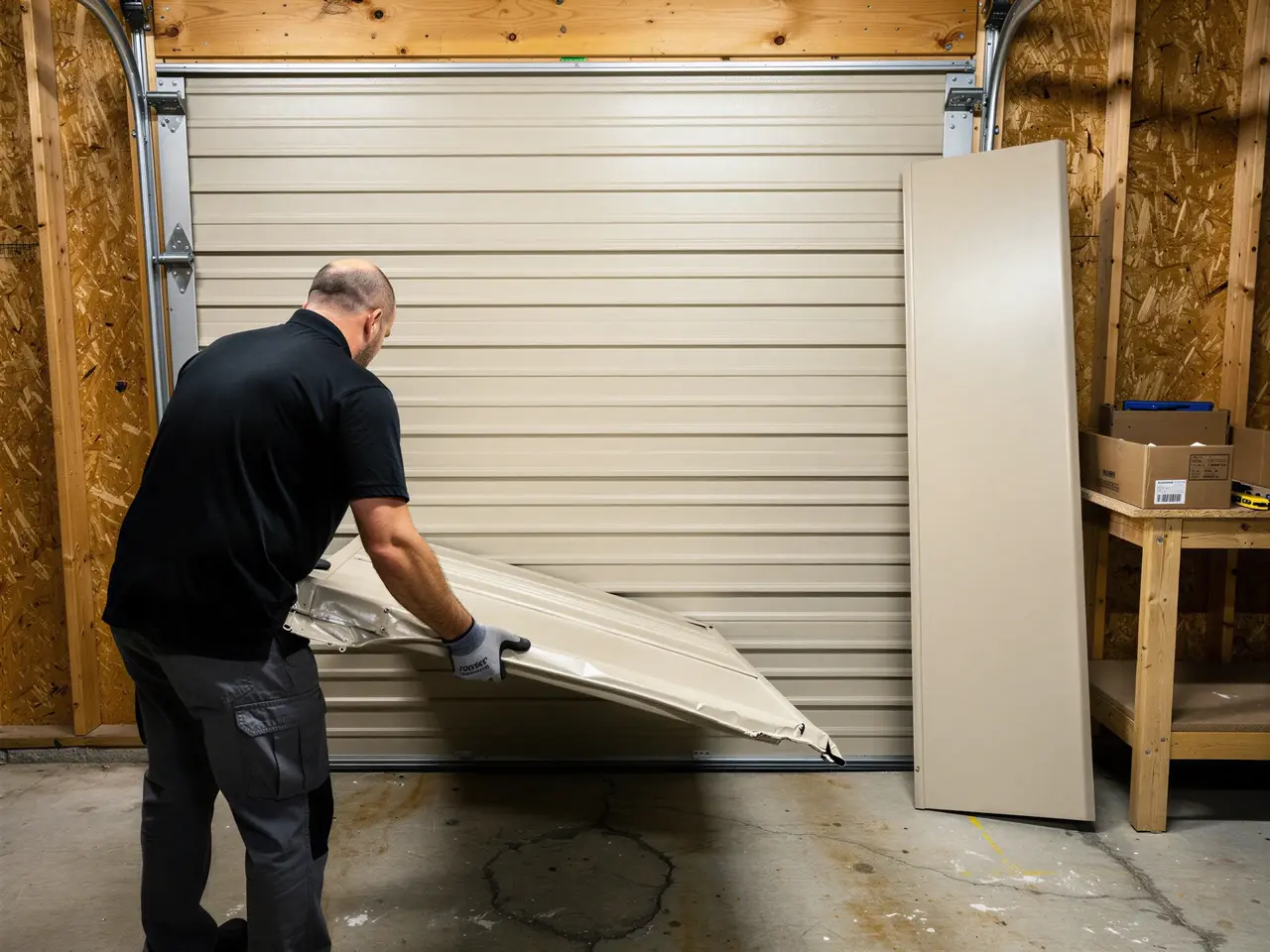
First step is identifying the door - manufacturer, panel design, section height, insulated or not. On a 1990s steel door that's often still readable off a label inside the garage; if it's worn off, we match by measuring the panel and checking the hardware spacing. If the exact panel isn't available, which does happen on older discontinued lines, we'll tell you that up front rather than stall the job - sometimes the honest answer is a full new section that doesn't perfectly match color, or in a few cases replacing the whole door is cheaper than chasing one obsolete panel. Once we've got the right section, it's a matter of pulling the end hinges, pulling the old panel off the track rollers, setting the new one, and reattaching hinges and rollers before cycling the door a few times to check it's running true and not binding.
Parts We Carry
We stock common steel sectional panel sections and the hardware that goes with them - hinges, roller brackets, end caps - sized for the door ages typical of this part of the service area. We carry what covers 1980s through 2000s builder-grade doors most reliably, since that's the bulk of what's out there across our coverage. What we don't keep on the truck is discontinued or specialty panel runs - wood composite, custom window inserts, anything from a manufacturer that's since changed its panel profile. Those get special-ordered, and that adds lead time we won't pretend isn't there. We bring stock out from Pooler, about 9 miles in, so a straightforward panel swap on a common steel door is usually a one-trip job; anything needing a special order means a second visit once the part's in.
Frequently asked questions
How old are most garage doors in Georgetown?
Housing here centers on a median build year of 1995, putting most original doors at steel sectional construction from the 1990s builder-grade era. That's newer than a lot of the broader service area, where the overall median build year runs closer to 1990, so Georgetown doors are a bit more likely to still be on their original steel panels.
Can you match just one damaged panel instead of replacing the whole door?
Usually yes, if the panel is still in production or close enough in profile and color. Steel sectional doors from the 1990s tend to be easier to match than older designs. If the exact panel's discontinued, we'll say so rather than force a mismatch, and we'll talk through whether a new section or a full door replacement makes more sense.
Do you have a shop in Georgetown?
No - we run out of Pooler, about 9 miles away, and bring panel stock and hardware out with us. For most common steel panel jobs that's a single trip; special-order parts mean a second visit once they arrive.
Does the climate here cause panel damage?
The area sits in a mild climate band with occasional freeze, so you're not dealing with the deep freeze-thaw cracking that splits panels in colder regions. The bigger factor is humidity and standing moisture at the bottom seam, which rusts steel panels over the decades if weatherstripping and drainage aren't kept up.
More garage door services in Georgetown
Book garage door service in Pooler
Call now or request a quote - tell us what the door is doing and where you are.